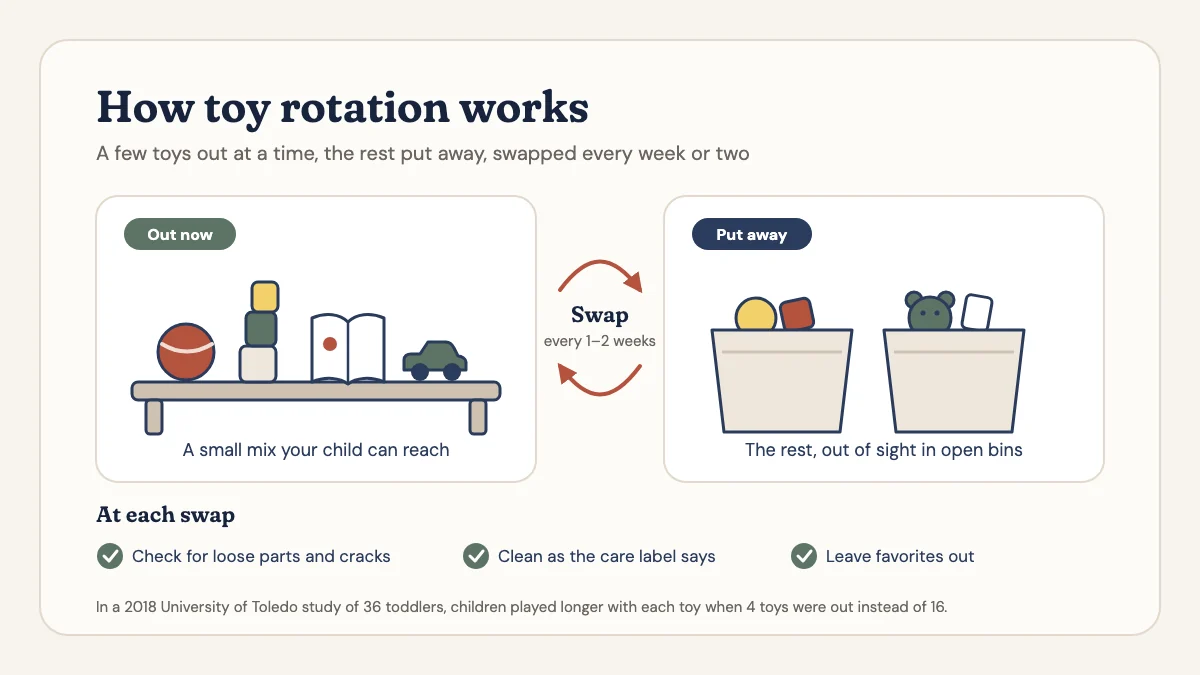
Many families end up with more toys than floor space, especially after birthdays and holidays. Toy rotation is a simple fix: keep a few toys out, put the rest away, and swap them every so often. Your child gets “new” toys, and you don’t buy anything.
What the research found
In a 2018 study from the University of Toledo, researchers watched 36 toddlers aged 18 to 30 months play in a playroom on two visits: once with four toys and once with sixteen. With fewer toys, the toddlers switched toys less often, played with each toy for longer and used the toys in more different ways. The researchers suggest that fewer toys may help toddlers focus and play more creatively.
It was one small study, in a playroom rather than at home. But a rotation costs nothing to try.
How to start
- Gather everything. Bring all the toys to one place. Set aside anything broken, and toys your child has outgrown or isn’t old enough for yet.
- Sort by kind of play. The AAP groups traditional toys into pretend play, building and puzzles, art, books and games, and active play. A mix of these makes a good set.
- Put a few out. Choose one or two from each group and keep them on a low shelf or in an open basket your child can reach. There’s no magic number: the study compared four toys with sixteen. Start small and adjust.
- Store the rest out of sight. A closet shelf or a bin is fine. Out of sight is what makes a toy feel new again.
- Swap every week or two, or whenever interest fades. Leave favorites and comfort toys out.
Make each swap a quick safety check
Rotation is a natural moment to look over every toy that’s going back out. The CPSC recommends checking toys regularly and repairing or throwing away any that are damaged. Look for:
- Loose or missing parts, cracks, and edges that have become sharp
- Torn seams on stuffed toys, and eyes or buttons coming loose
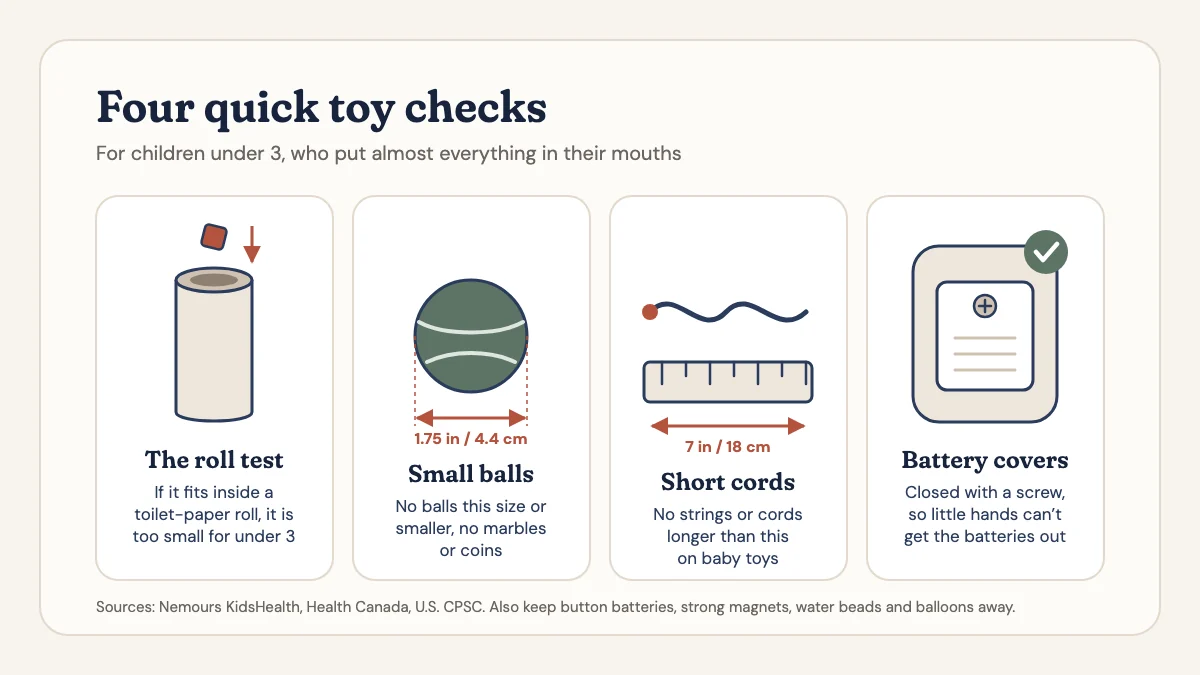
- Battery covers with a missing screw
- Toys meant for older children that have crept into the mix
- Toys that need a wash. Follow the care label, which on many soft toys says whether they’re washable.
Store toys safely
Health Canada suggests keeping toys at floor level, so a child can’t pull them down from above, and using open baskets or canvas bins. Avoid toy chests with heavy lids that can fall on a child. If you do use a toy chest, the CPSC says its lid should stay open in any position and the chest should have air holes. Never let children play in airtight bins or boxes they could climb into.
When to let a toy go
- It’s broken, or can’t be repaired safely.
- It belongs to an older child and has small parts. Store it where the baby can’t reach.
- Nobody has touched it for several rotations. If it’s in good shape and hasn’t been recalled, pass it on.
Looking for ideas for the mix? See how to choose toys, age by age, and run new toys through our toy safety checklist.
Sources
- Dauch C, Imwalle M, Ocasio B, Metz AE. The influence of the number of toys in the environment on toddlers’ play. Infant Behavior and Development, 2018; 50: 78–87
- American Academy of Pediatrics, HealthyChildren.org: Toy Buying Tips for Babies & Young Children, based on the AAP report “Selecting Appropriate Toys for Young Children in the Digital Era” (2019)
- U.S. Consumer Product Safety Commission: For Kids’ Sake: Think Toy Safety (PDF)
- Health Canada: Toy safety tips
This guide is general information, not medical advice. In an emergency, call 911.