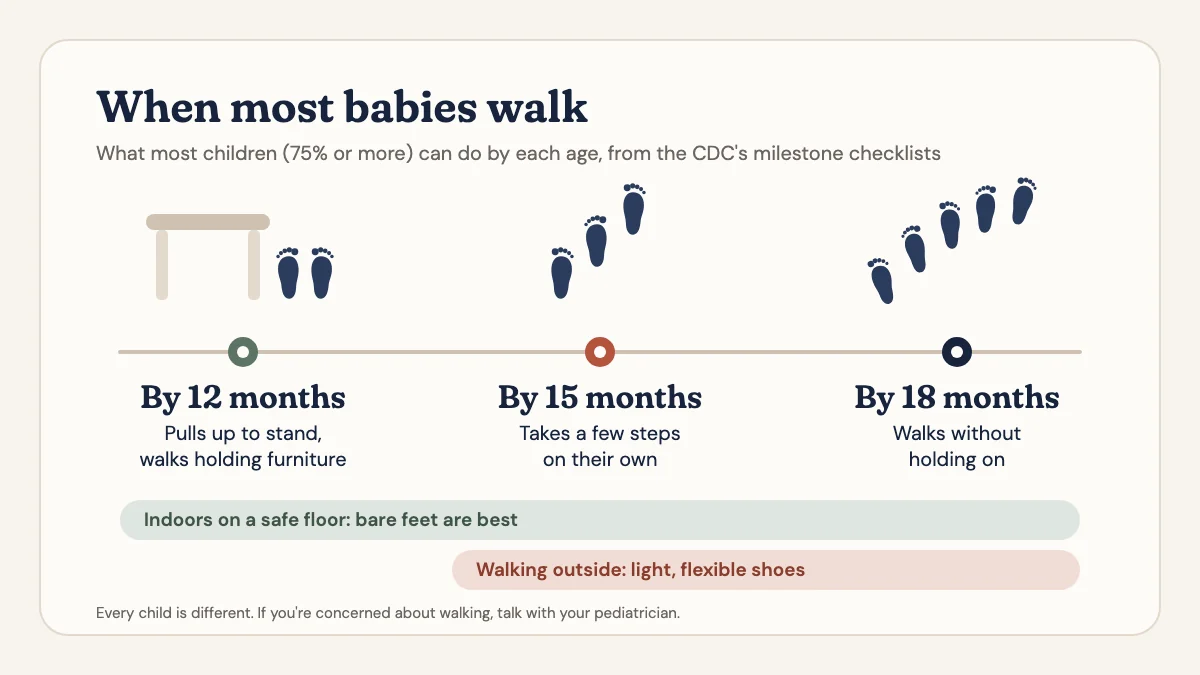
The short answer: when your baby is walking on their own and you’re heading outside. Until then, and at home on a safe floor, bare feet are usually best.
Tiny shoes are hard to resist, and it’s easy to buy a pair months before anyone needs them. Here is what children’s health groups say about first shoes, and what to look for when you’re ready to buy.
Before your baby walks, skip the shoes
Babies who are crawling, pulling up and cruising along the sofa use their feet to feel the floor and keep their balance. Nemours KidsHealth suggests waiting on shoes until your baby is walking. Shoes are mainly there to protect feet outdoors, and putting them on early won’t help a baby walk any sooner. Stiff, hard soles can even make learning harder, because they limit how the foot bends.
If your floors are chilly, socks or soft booties with non-slip soles keep toes warm without getting in the way.
When most babies start walking
There’s a wide normal range. The CDC’s milestone checklists list what most children (75% or more) can do by a certain age:
- By 12 months: pulls up to stand and walks while holding on to furniture.
- By 15 months: takes a few steps on their own.
- By 18 months: walks without holding on to anyone or anything.
Lots of babies walk earlier or later than this. If you’re worried about your child’s walking, or they’ve stopped doing something they used to do, bring it up with your pediatrician. The CDC’s advice is not to wait.
When shoes start to make sense
Once your child is walking, shoes earn their keep outside: hot or rough sidewalks, the playground, parking lots, anywhere there might be something sharp underfoot. The Canadian Paediatric Society notes that for children who have just started walking, shoes can help prevent accidental injuries.
Some daycares ask for shoes too, and a grippy sole helps on slick floors. Plenty of families keep bare feet as the default at home and put shoes on at the door.
What to look for in a first pair
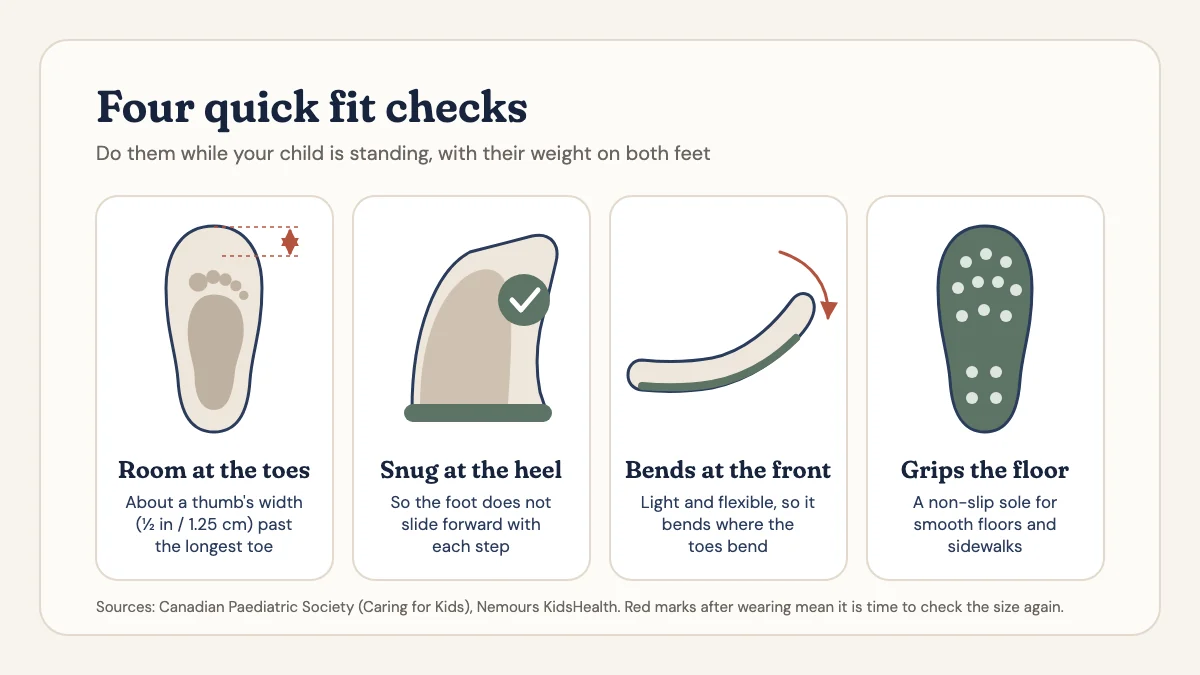
- Flexible. You should be able to bend the shoe easily at the front, where the toes bend.
- Light. A heavy shoe makes every step more work.
- Non-slip. The sole should grip smooth floors.
- The right size. About a thumb’s width (roughly ½ inch, or 1.25 cm) between the longest toe and the tip of the shoe while your child stands, and snug at the heel.
- Easy on, hard to kick off. Hook-and-loop straps or a stretchy collar help. A high top doesn’t give a young walker more support, but it can be harder for them to pull off.
Our guide to measuring your baby’s feet at home goes through the size part step by step.
Do first walkers need arch support?
Usually not. Almost all children under 18 months have flat-looking feet, and the arch develops over the first few years. The Canadian Paediatric Society says most children never need special or “corrective” shoes, because feet and legs change naturally as children grow. If your child seems to be in pain when they walk, check with your doctor.
The short version
- Bare feet at home, on a safe floor.
- Socks or soft booties for warmth before walking.
- Light, flexible shoes once your child walks outside, with a little room to grow.
Want the whole picture from newborn to walker? See socks, booties or shoes, stage by stage. Shopping for a first pair? Our soft-sole first walkers come in sizes 3 to 7, and every product page has a size chart by foot length.
Sources
- Nemours KidsHealth: Is My Baby Ready for Shoes?
- CDC, Learn the Signs. Act Early.: milestones by 1 year, 15 months and 18 months
- Canadian Paediatric Society, Caring for Kids: Footwear for children
This guide is general information, not medical advice. If you have questions about your child’s feet or walking, talk with your pediatrician.