Toys sold in the U.S. have to meet federal safety rules, and the AAP says most toys are safe when they’re used at the right age. Unsafe toys still turn up, though, and an older child’s toy can be a hazard for a baby. These checks take a minute and catch the most common problems.
1. Read the age label
The age on the package is mainly a safety guide, not a measure of how advanced your child is. Health Canada notes that age labels help reduce the risk of choking, strangulation and hearing damage in younger children. The CPSC says a toy labeled for ages 3 and up should be kept away from children under 3, because it may have small parts.
2. Do the toilet-paper-roll test
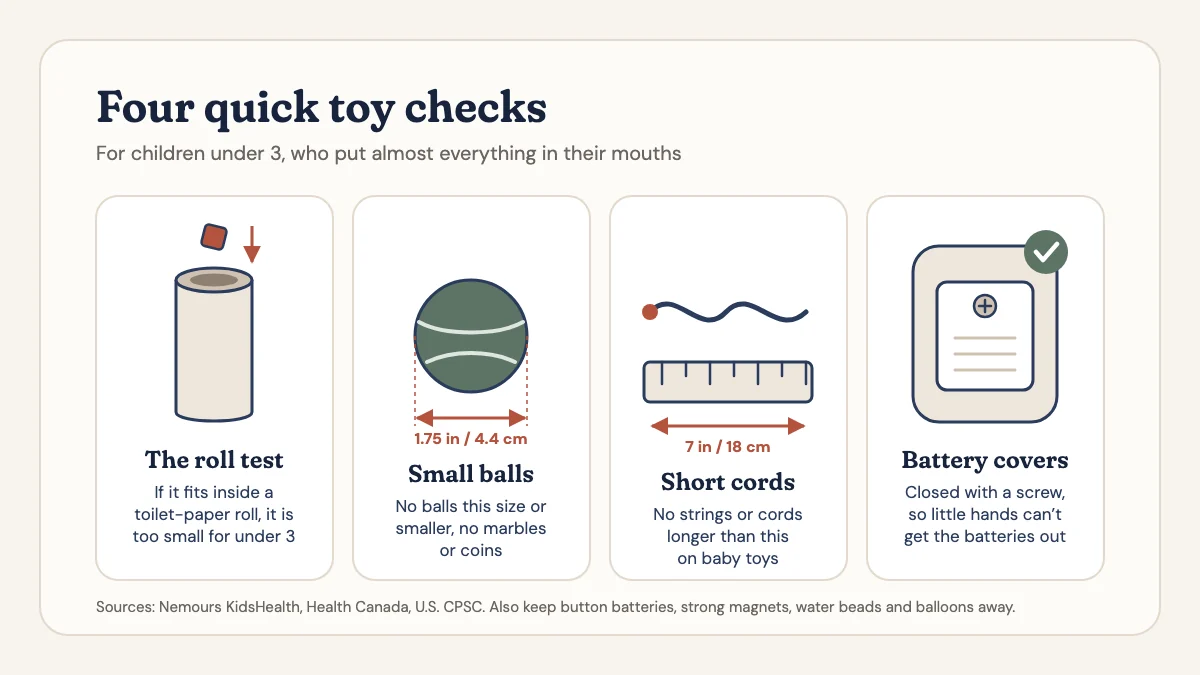
Children under 3 put almost everything in their mouths, and U.S. law bans small parts in toys made for them. For a quick check at home, use an empty toilet-paper roll. If a toy, or any piece that could come off it, fits inside the roll, it’s too small for a child under 3. Nemours KidsHealth explains that small-parts testers are made about as wide as a young child’s windpipe, and a toilet-paper roll works the same way.
Pieces that come off are easy to miss. Health Canada and the CPSC point to:
- Eyes and noses on stuffed toys and dolls
- Squeakers inside squeeze toys
- Wheels and tires on small cars and trucks
- Buttons, beads and marbles
- Loose puzzle pieces, and parts from an older child’s building set
3. Watch out for small balls
Round things are a special risk, because they can block the throat. KidsHealth advises avoiding balls 1.75 inches (4.4 cm) across or smaller, as well as marbles and coins. U.S. rules don’t allow balls that small in toys for children under 3.
4. Check batteries and magnets
- Battery covers should close with a screw, so children can’t open them.
- Button batteries, the small coin-shaped kind, are very dangerous if swallowed. The AAP suggests avoiding toys that use them.
- Strong magnets are on the AAP’s avoid list too. Health Canada explains that if a child swallows more than one, they can damage the gut.
- Water beads, the small gel balls that grow in water, can swell after they’re swallowed and cause a blockage. Keep them away from babies and toddlers.
If you think your child has swallowed a button battery, don’t wait. Call Poison Help at 1-800-222-1222 or the National Battery Ingestion Hotline at 1-800-498-8666 right away. The National Capital Poison Center says a battery stuck in the throat can cause severe damage in as little as two hours. Swallowed magnets need a doctor right away too.
5. Look for cords, sharp edges and pinch points
- No strings or cords longer than 7 inches (18 cm) on toys for babies.
- Take down toys that stretch across the crib or playpen, like crib gyms, once your baby starts to push up on hands and knees or at 5 months, whichever comes first.
- No sharp edges or points, and no gaps or hinges that could pinch little fingers.
- Sturdy enough to survive chewing and throwing without breaking into pieces.
6. Keep balloons away from young children
Uninflated balloons and pieces of popped ones are a serious choking risk. The CPSC says more children have suffocated on them than on any other kind of toy. KidsHealth advises keeping balloons, and latex or vinyl gloves, away from children under 8.
7. Listen before you buy
Some toys are surprisingly loud. Health Canada suggests testing a noisy toy yourself: if it sounds uncomfortable to you, it may be too loud for your child. Keep toys that make sounds away from your child’s ears.
8. Take a closer look at hand-me-downs
- Older and homemade toys may never have been safety tested, so check them carefully.
- Don’t give babies or toddlers painted toys made before 1978. The paint may contain lead.
- Check for recalls at cpsc.gov/Recalls or Recalls.gov.
9. Check again after you unbox, and over time
- Throw away plastic bags, wrap and twist ties right away.
- Every so often, look for loose parts, cracks and broken pieces. The CPSC says to repair a damaged toy or throw it away.
- Keep older siblings’ toys out of a baby’s reach.
If something goes wrong
You can report an unsafe toy, or an injury, to the CPSC at SaferProducts.gov or by calling 1-800-638-2772. It’s also worth telling the company that made it.
The short version
- Follow the age label.
- Under 3: nothing that fits inside a toilet-paper roll, and no balls 1.75 inches (4.4 cm) or smaller.
- No button batteries, strong magnets, water beads or balloons for young children.
- No long cords. Crib toys come down at 5 months, or sooner if your baby pushes up.
- Check toys often, and throw out broken ones.
Choosing new toys? See how to choose toys, age by age. Swapping toys in and out? A toy rotation is a good time to run these checks.
Sources
- Nemours KidsHealth: Choosing Safe Toys for Babies
- Health Canada: Toy safety tips
- U.S. Consumer Product Safety Commission: Which Toy for Which Child: Ages Birth Through Five (PDF)
- U.S. Consumer Product Safety Commission: For Kids’ Sake: Think Toy Safety (PDF)
- American Academy of Pediatrics, HealthyChildren.org: Toy Buying Tips for Babies & Young Children, based on the AAP report “Selecting Appropriate Toys for Young Children in the Digital Era” (2019)
- National Capital Poison Center: Ingested a battery? Here’s what to do
This guide is general information, not medical advice. In an emergency, call 911.