The short answer: pick simple, sturdy toys that fit what your child is learning to do right now, and let your child do the work. Check the age label too. It’s there for safety.
Toy aisles are full of things that light up, talk and promise to make babies smarter. The American Academy of Pediatrics (AAP) and ZERO TO THREE, a nonprofit focused on early childhood, both point parents back to the basics. Here’s what they suggest, and how it looks from birth to age 3.
What makes a good toy
- It fits their skills, with a little stretch. The AAP says the best toys match what a child can do now and encourage new skills.
- It can be used in many ways. Blocks, stacking cups and balls can be a tower today and a road tomorrow. ZERO TO THREE calls these open-ended toys.
- Your child does the work. ZERO TO THREE notes that the more a toy does on its own, the less your child does. If your child mostly sits and watches, the toy is closer to entertainment.
- You can play with it together. Books, simple games and pretend play give you something to share. The AAP says digital toys should never take the place of face-to-face play.
- It’s safe for this age. Follow the age label and check for small parts. Our toy safety checklist covers what to look for.
Birth to 6 months: look, listen, grab
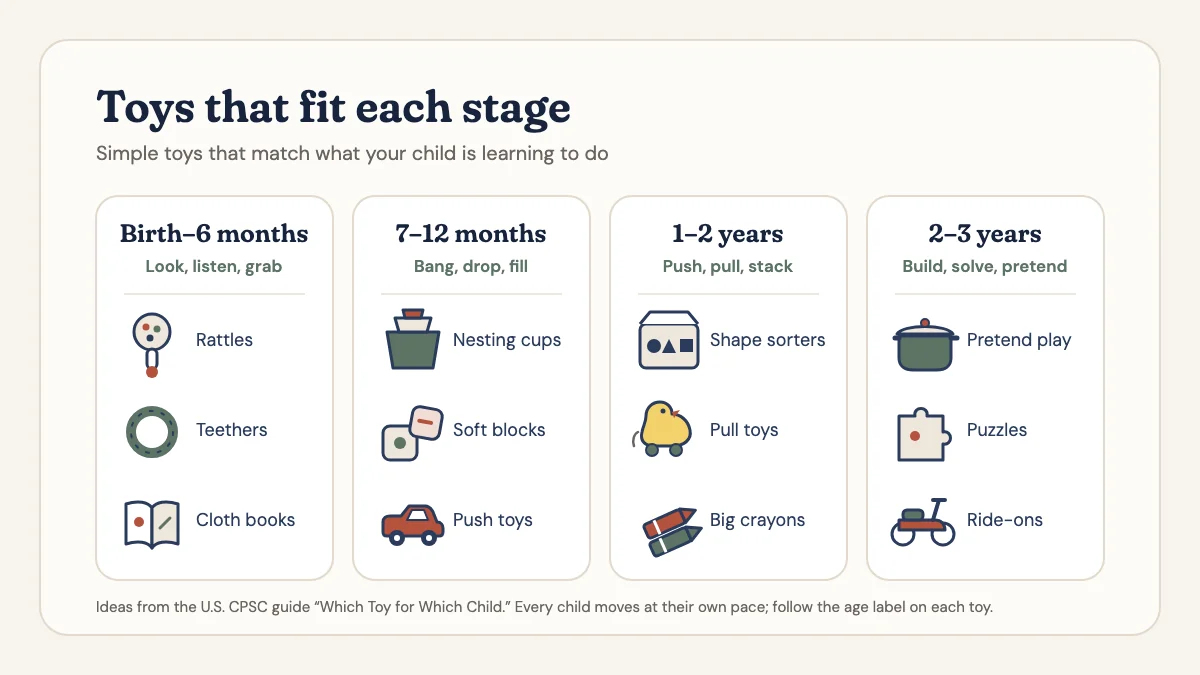
Young babies explore with their eyes, ears, hands and mouth. The U.S. Consumer Product Safety Commission (CPSC) guide to toys by age suggests things to look at, listen to, hold and chew:
- Simple rattles and teethers
- Light, soft cloth toys and squeeze toys
- Toys to bat at and grab
- A large, unbreakable mirror
- Books, read aloud to them
Babies this age like bright colors, high contrast, simple designs and faces. Everything goes in the mouth, so toys need to be too big to swallow, with no sharp edges and no long strings.
7 to 12 months: bang, drop, fill and empty
Now babies want to bang, shake, poke, drop and throw things, and to put things in and take them out again. Good choices from the CPSC guide:
- Soft or rubber blocks
- Nesting cups and simple stacking rings
- A container with a few objects to empty and fill
- Activity boxes and easy pop-up toys
- Simple push toys, like a car or an animal on wheels
- Big balls, too large to fit in the mouth
- Cloth, plastic and board books, and simple floating toys for the bath
1 to 2 years: push, pull, stack and copy
Young toddlers are on the move. They like to carry, dump, push, pull, pile up and knock down, and they start copying what you do. The CPSC guide suggests:
- Push toys, and pull toys once they walk steadily
- Ride-on toys they move with their feet, without pedals
- Stacking blocks and large blocks that press together
- Shape sorters with a few common shapes, and puzzles with 2 to 5 big pieces (knobs make them easier)
- Pretend-play basics: a soft doll, a toy phone, toy dishes
- Large crayons and big sheets of paper
- Sturdy board books with only a few pages
2 to 3 years: build, solve and pretend
Two-year-olds love active play, begin to play alongside other children and pretend more and more. ZERO TO THREE says creativity really takes off in the third year. Toys that fit this stage:
- Pretend play: dolls, toy food, dress-up clothes, a toy kitchen, trucks and trains
- Blocks and building sets with large pieces
- Puzzles with a few more pieces: about 4 or 5 at first, up to 12 by age 3
- Art supplies: big crayons, non-toxic paints, clay or play dough
- Balls, wagons and ride-ons, and a small tricycle once they start to pedal
- Books with short, simple stories and lots of repetition
A few things to skip
- Toys that do everything. Lots of buttons, lights and music can leave a child just watching.
- “Educational” screens and apps. The AAP says most apps sold as educational aren’t. It advises no screen time before age 2, and less than an hour a day after that.
- Toys labeled for older children. A “3+” label can mean small parts. The CPSC says to keep these away from children under 3, and that includes an older sibling’s sets.
- Button batteries and strong magnets. The AAP advises avoiding toys that have them.
You don’t need a lot of toys, either. A small study found toddlers played longer and in more ways when fewer toys were around. Our guide to toy rotation shows an easy way to use that at home.
Sources
- American Academy of Pediatrics, HealthyChildren.org: Toy Buying Tips for Babies & Young Children, based on the AAP report “Selecting Appropriate Toys for Young Children in the Digital Era” (2019)
- ZERO TO THREE: Tips for Choosing Toys for Toddlers
- U.S. Consumer Product Safety Commission: Which Toy for Which Child: Ages Birth Through Five (PDF)
This guide is general information, not medical advice. In an emergency, call 911.